
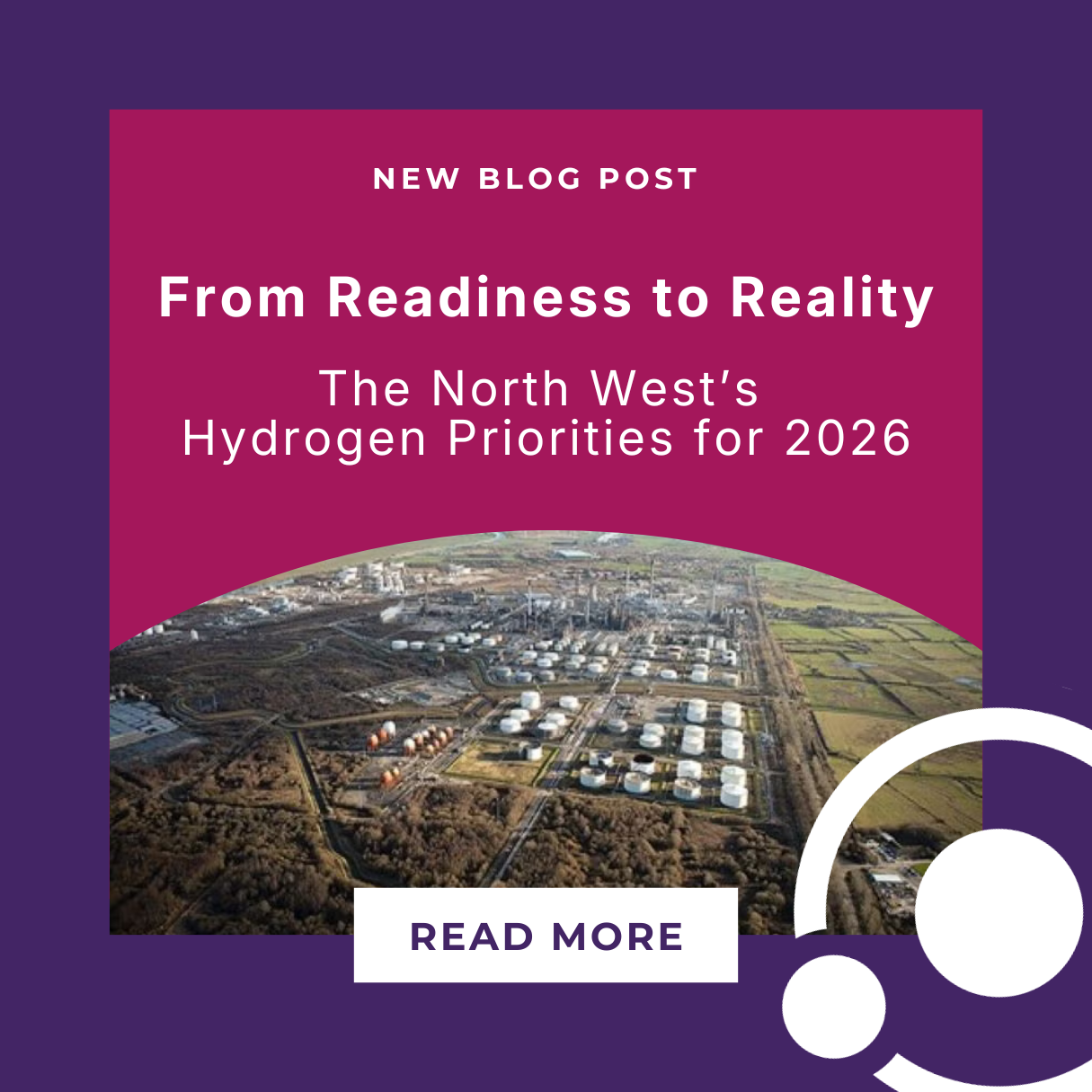
From Readiness to Reality: The North West’s Hydrogen Priorities for 2026
We enter 2026 on the back of a busy and important year for UK hydrogen. Since the publication of the UK’s low-carbon hydrogen strategy in 2021, significant progress has been made in establishing the foundations of a domestic hydrogen economy. Government has set production ambitions, introduced a pragmatic Low-Carbon Hydrogen Standard and developed business models designed to unlock private investment.
That progress became more tangible during 2025. Mechanisms such as the Hydrogen Allocation Rounds and the Cluster Sequencing process began to move hydrogen from policy intent towards real projects. For the North West, home to the UK’s most advanced industrial cluster, these steps have been critical in building confidence and readiness, with projects now moving beyond development and towards construction and operation.
As a result, the UK hydrogen sector enters 2026 with real momentum. The foundations are largely in place, projects are ready to move forward and regions like the North West are prepared to deliver at scale. What is now required is a decisive shift from ambition to action. The refreshed Hydrogen Strategy delayed from the end of last year is expected imminently and must set out a credible, delivery-focused vision for the rest of the decade, providing long-term certainty for investors and industry, whilst clearly defining hydrogen’s role within the wider energy system.
So, what is the North West Hydrogen Alliance hoping to see in 2026?
We need greater clarity on demand and to clearly identify priority end-uses, with support mechanisms in place for offtakers. This clarity is crucial as North West hydrogen projects such as EET Hydrogen’s HPP1 low-carbon hydrogen production plant at Stanlow, which is progressing toward construction and commissioning, prepare to deliver early volumes to industrial customers. Whilst manufacturers position to offtake hydrogen for decarbonisation of glass and other processes.
HyNet North West and Cadent’s planned 100 km hydrogen pipeline network requires a coordinated plan for hydrogen infrastructure, including pipelines and storage, with a regional approach that recognises where hydrogen can be deployed fastest and most effectively. At the same time, government must act to secure the UK’s supply chain opportunity, ensuring that investment into projects involving partners such as Eni through Liverpool Bay CO₂ transport and storage project, and the broader HyNet cluster, translates into domestic jobs, skills development and manufacturing growth across the North West.
With the industrial base, infrastructure and project pipeline already in place, the North West is uniquely positioned to lead the next phase of the UK’s hydrogen transition. With the right signals from government in 2026, the region stands ready to turn national ambition into real-world delivery.